If you are planning a trip to Yellowstone in August you are about to be in the right place at exactly the right time.
The Perseid meteor shower is the most watched meteor shower of the entire year. It peaks every August and at its best you can see dozens of meteors streaking across the sky every single hour. And if you happen to be watching from a Bortle Class 1 dark sky like the one right outside your door at Old Faithful RV Park, the show is genuinely extraordinary.
This is your complete guide to the Perseid meteor shower near Yellowstone in 2026, when to watch, where to go, and why this part of Wyoming is one of the best places in the country to see it.
What Is the Perseid Meteor Shower?
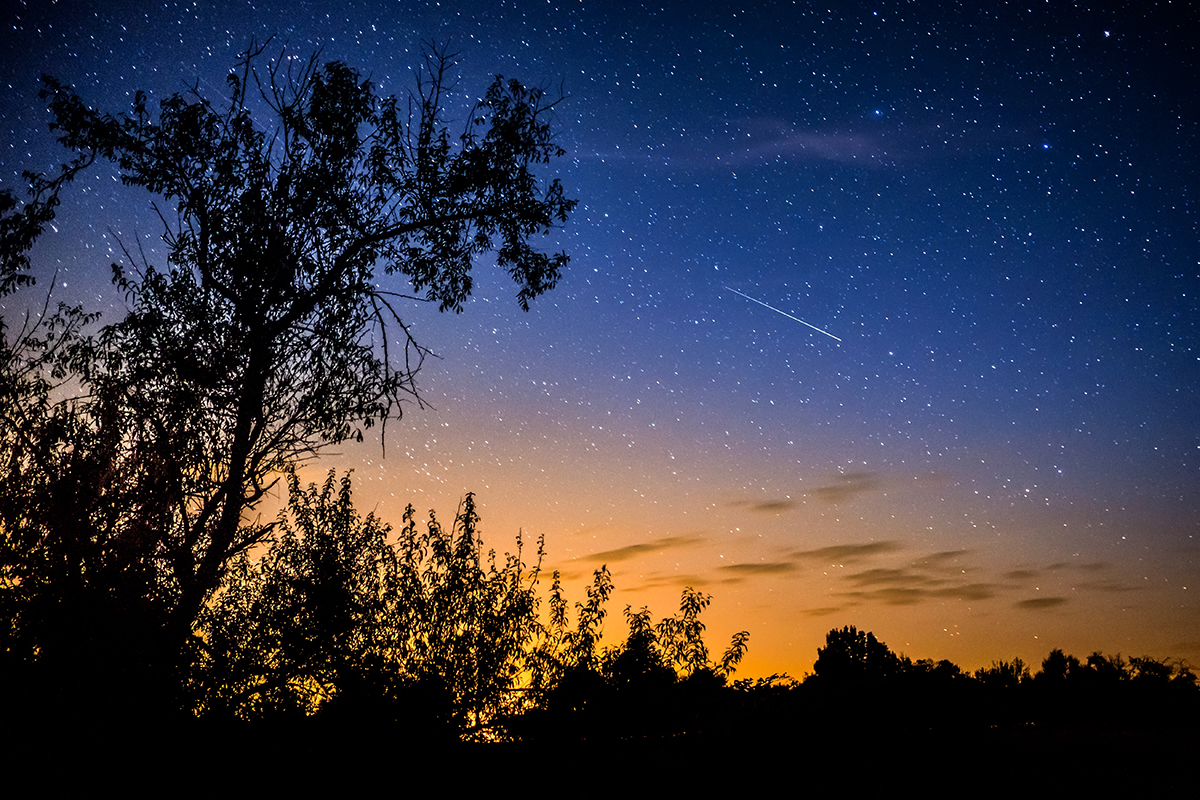
A meteor blazes across the sky just after twilight, the kind of early evening sighting that happens even before peak viewing hours at a dark sky location near Yellowstone.
The Perseid meteor shower happens every year in mid-August when the Earth passes through the debris trail left behind by Comet Swift-Tuttle. As tiny pieces of comet dust enter the atmosphere at around 37 miles per second they burn up and create the bright streaks of light we call meteors or shooting stars.
The Perseids are named after the constellation Perseus because that is the direction the meteors appear to come from in the night sky. But you do not need to find Perseus to enjoy the show. Meteors can appear anywhere across the sky so the best strategy is simply to lie back, look up, and let your eyes take in as much sky as possible.
At peak the Perseid meteor shower can produce anywhere from 50 to 100 meteors per hour under ideal conditions. Even on a good night away from peak you might see 20 to 30 meteors per hour. From a Bortle Class 1 sky like the one at Old Faithful RV Park even the fainter meteors that get washed out by light pollution elsewhere are clearly visible.
Learn more about the science behind the Perseids at NASA’s official Perseid guide.
For anyone planning a Perseid meteor shower near Yellowstone trip this August, understanding what you are actually watching makes the experience even more meaningful.
When Is the Perseid Meteor Shower in 2026?
The Perseid meteor shower is active from mid-July through late August but the peak viewing nights in 2026 are:
August 11 and 12, 2026
If you are planning to watch the Perseid meteor shower near Yellowstone mark these two dates on your calendar right now.
These are the two nights when meteor activity is at its absolute highest. If you can only pick one night to watch, August 12th is typically the strongest.
The best viewing window each night is from midnight to about 3am when Perseus is high in the sky and the Earth is turning directly into the meteor stream. However Perseids can be spotted any time after dark, so even an early evening session starting around 10pm can produce great sightings, especially from a dark sky location.
For the most current and detailed Perseid activity predictions visit the American Meteor Society.
Why the Perseid Meteor Shower Is Special This Year
Every year the Perseid meteor shower near Yellowstone is worth the late night. But 2026 has one extra advantage worth knowing about. Every year the Perseid meteor shower is worth watching. But 2026 has one extra advantage worth knowing about.
The moon phase around the peak dates in 2026 is favorable for dark sky viewing. A darker moon phase means less moonlight washing out the fainter meteors, which translates to more visible meteors per hour. Check a moon phase calendar before your trip so you know exactly what to expect on your viewing nights.
What Is a Bortle Class 1 Sky and Why Does It Matter?
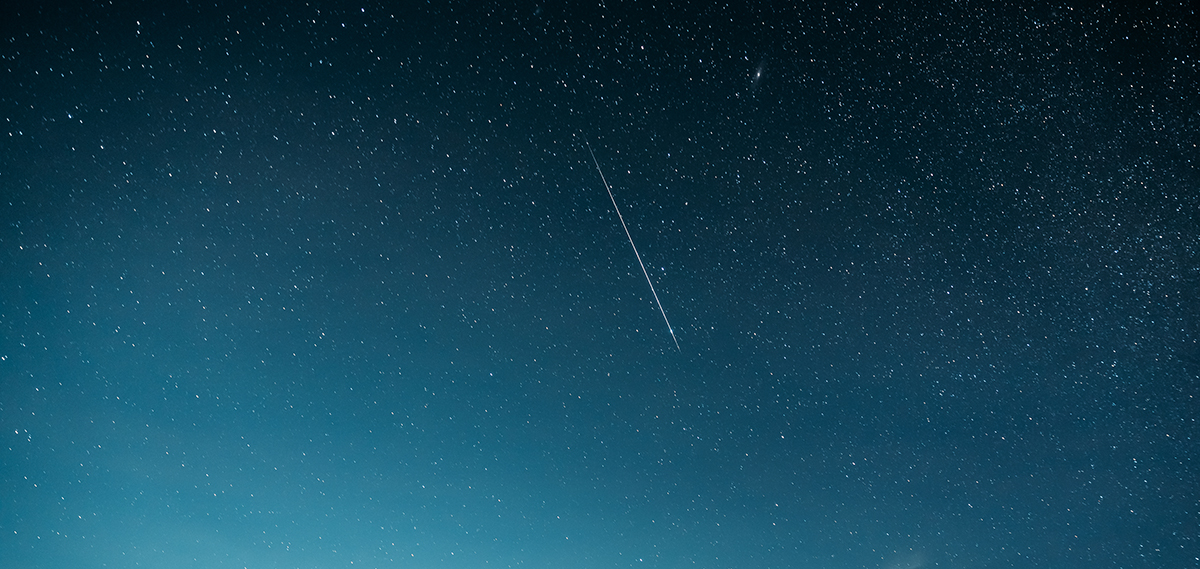
Single meteor cutting through the center, exactly what a Bortle Class 1 sky looks like when the conditions are right.
You will hear the term Bortle Class 1 when you read about Old Faithful RV Park and it is worth understanding what it actually means.
The Bortle scale rates the darkness of the night sky from 1 to 9. Class 9 is the sky above a brightly lit city center where you might only see a handful of the brightest stars. Class 1 is the darkest sky possible, the kind of sky that existed everywhere before electric lighting, where the Milky Way is so bright it casts shadows and thousands of individual stars are visible to the naked eye.
Old Faithful RV Park sits in a Bortle Class 1 sky. That means no city glow on the horizon, no light pollution washing out the fainter stars, and no competing artificial light sources dimming the show. For the Perseid meteor shower this matters enormously. For the Perseid meteor shower near Yellowstone this means every faint streak that would be invisible from a city or suburb is clearly visible from your campsite. From a Bortle Class 1 location you can see meteors that would be completely invisible from even a reasonably dark suburban backyard.
Many sites in the Yellowstone region are classified as Bortle Class 1 on the Bortle Dark Sky Scale, meaning they have the best possible night sky viewing conditions. Old Faithful RV Park is right in the heart of that corridor making it one of the finest spots for the Perseid meteor shower near Yellowstone.
Where to Go Stargazing Near Yellowstone for the Perseids
Old Faithful RV Park — The Best Basecamp for the Perseids. For most visitors watching the Perseid meteor shower near Yellowstone this is the simplest and most comfortable option available.
The simplest and most comfortable option is to watch right from your campsite at Old Faithful RV Park. Step outside after dark, set up a camp chair or lay a blanket on the ground, and look up. No driving, no hiking, no complicated logistics. Just you, the North Fork of the Shoshone River, and one of the darkest skies in the country.
The wide open Wyoming sky above the Wapiti Valley gives you a clear view from horizon to horizon, which is exactly what you want for meteor watching. The Absaroka Mountains frame the horizon beautifully on clear nights and the river sounds make the whole experience even more peaceful.
Inside Yellowstone National Park
If you want to combine meteor watching with Yellowstone’s iconic landscapes there are several excellent spots inside the park. Yellowstone is working toward becoming an officially recognized International Dark Sky Park. Read more about the park’s commitment to dark sky preservation at the NPS Yellowstone Dark Skies page.
Hayden Valley: Wide open meadows with unobstructed views in every direction. One of the best wildlife watching spots in the park during the day and an outstanding stargazing location at night. Just remember that all of Yellowstone is bear country after dark. Carry bear spray, go with a buddy, and stick to your vehicle or well-lit pullouts. Hayden Valley is one of the top choices for watching the Perseid meteor shower near Yellowstone inside the park itself.
Lamar Valley: One of the darkest spots in the entire park with minimal artificial light and wide open skies. Excellent for Perseid viewing but a significant drive from the East Gate at night. Plan carefully and always carry bear spray. For serious dark sky enthusiasts Lamar Valley rivals anywhere in the country for the Perseid meteor shower near Yellowstone.
Yellowstone Lake: The calm water creates a beautiful reflection of the night sky and the wide open horizon over the lake gives you great views of meteors descending toward the horizon. The lake reflection combined with the meteor shower makes Yellowstone Lake one of the most unique spots to experience the Perseid meteor shower near Yellowstone.
Dunraven Pass: At 8,859 feet this is the highest road in the park and offers incredible elevated views of the night sky. Pack extra layers as temperatures drop significantly at altitude even in August.
Tips for Watching the Perseid Meteor Shower Near Yellowstone
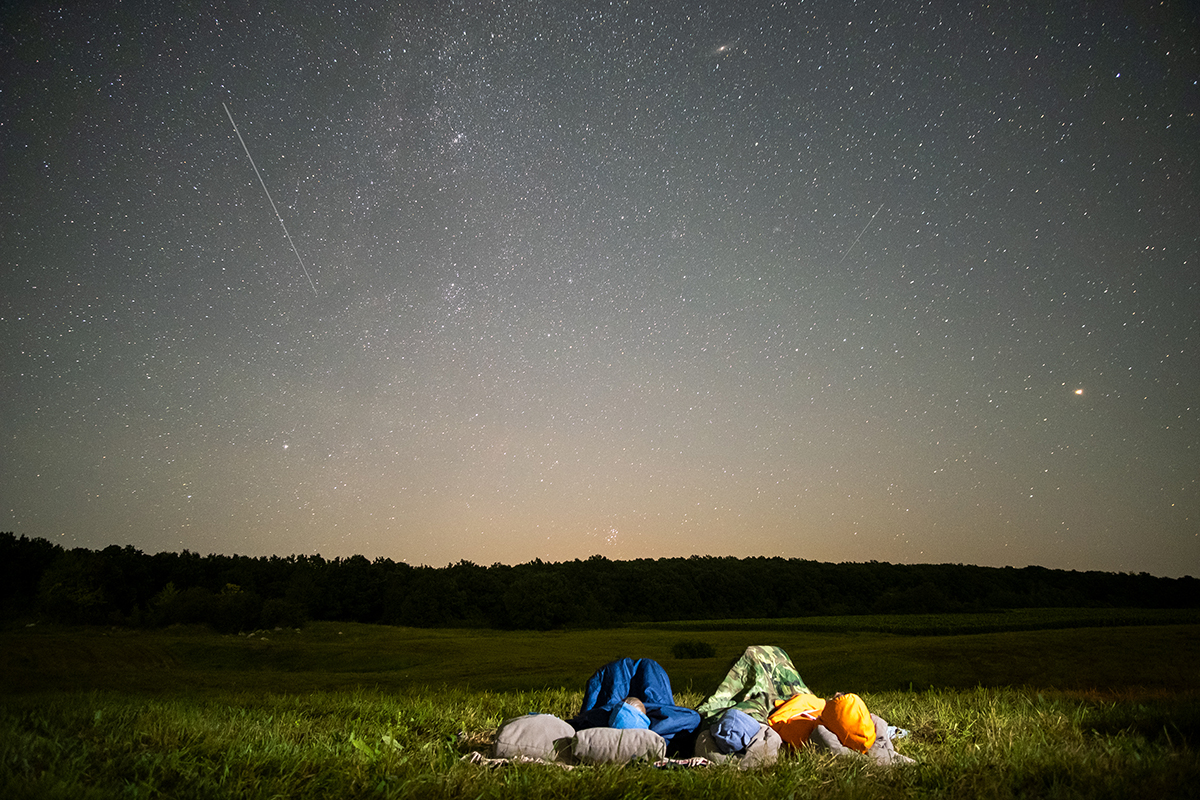
The right way to watch a meteor shower, flat on your back in a sleeping bag with the whole sky above you. Dark sky camping near Yellowstone makes nights like this possible.
Give your eyes at least 20 to 30 minutes to adjust. This is the most important tip for any stargazing session. Your eyes need time to adapt to the dark. The longer you stay out the more you will see. After a full 30 minutes your eyes can be three to four times more sensitive to faint light than when you first stepped outside. Getting the most out of the Perseid meteor shower near Yellowstone comes down to a few simple things done consistently.
Avoid your phone screen. Even a brief glance at a bright phone screen resets your night vision completely. If you need to check something use a red light setting on your phone or cover your screen with a red filter. White light is the enemy of dark adapted eyes.
Use a red flashlight. A red light lets you move around safely without destroying your night vision. Pick one up before your trip or check if your headlamp has a red light mode.
Lie flat on your back. Meteor watching is not a standing-up activity. The more sky you can see the more meteors you will catch. A reclining camp chair, a sleeping bag on the ground, or even just a blanket on a flat surface works perfectly.
Look toward Perseus but do not stare at it. The meteors appear to radiate from the direction of Perseus in the northeastern sky. But the actual streaks can appear anywhere overhead. A relaxed wide-angle gaze that takes in as much sky as possible works better than staring at one spot.
Dress warmly. August nights in the Wapiti Valley can get surprisingly cold even after warm summer days. Bring layers, a warm jacket, and a blanket. You will want to stay out for at least an hour to get the full experience and staying warm is the difference between a magical night and a miserable one. Being warm and comfortable is what separates a great Perseid meteor shower near Yellowstone experience from one cut short by the cold.
Download a stargazing app before you leave. Cell service is limited in the North Fork corridor so download your app at home before you head out. More on the best apps below.
Check the weather. Clear skies are essential. Check the forecast before committing to a late night Perseid meteor shower near Yellowstone session. Even partial cloud cover can significantly reduce what you see.
What Else Can You See During the Perseids?
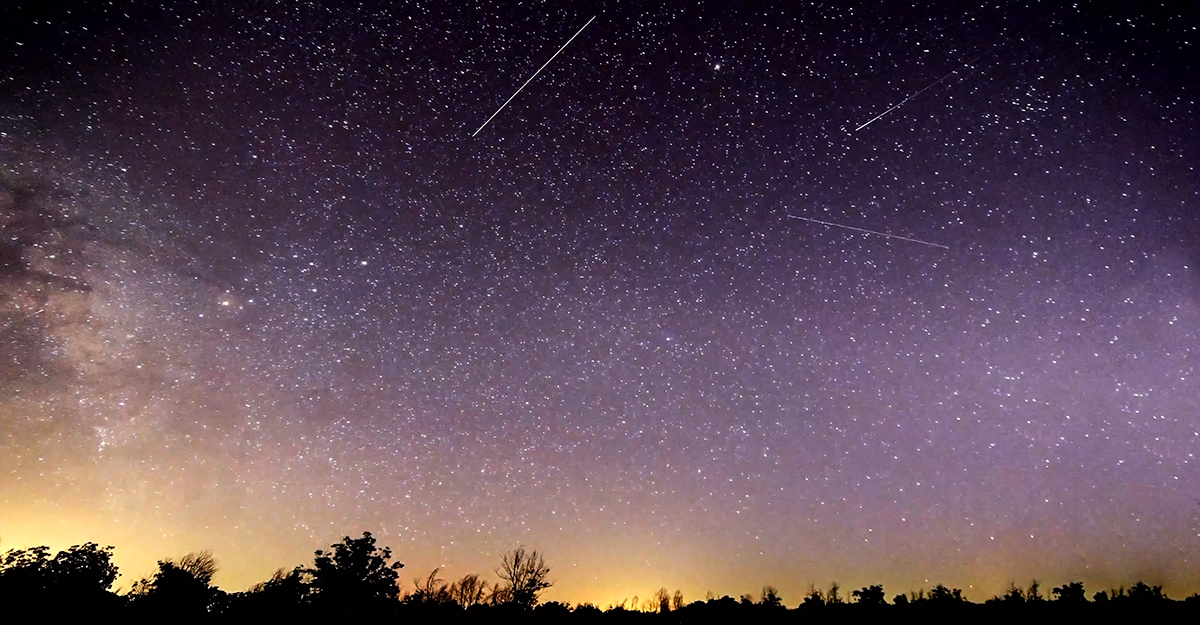
Multiple Perseid meteors cross the sky in a single long exposure shot, a glimpse of what peak activity looks like from a Bortle Class 1 dark sky location.
The Perseid meteor shower is the main event but on a clear Bortle Class 1 night there is plenty more to see:
The Milky Way stretches across the entire sky from horizon to horizon, bright enough to cast a faint shadow on the ground. Most people who see a truly dark sky Milky Way for the first time are genuinely stopped in their tracks. The Perseid meteor shower near Yellowstone is the headline but the supporting cast on a clear Bortle Class 1 night is extraordinary too. Seeing the Milky Way this clearly is one of the unexpected bonuses of planning a Perseid meteor shower near Yellowstone trip.
Planets are often visible and surprisingly bright. Jupiter appears cream colored and with binoculars you can often see its four largest moons. Saturn has a golden hue and on very clear nights its rings are visible even with a basic pair of binoculars.
Satellites cross the sky steadily every few minutes. The International Space Station passes over Wyoming regularly and is easy to spot with the naked eye, moving faster than any star but slower than a meteor. Satellite spotting is a fun extra activity during any Perseid meteor shower near Yellowstone viewing session.
Constellations are dramatically more visible from a dark sky than most people have ever experienced. Cassiopeia, Perseus, Scorpius, and Cygnus are all prominent in the August sky and serve as natural guideposts for orienting yourself to the night sky.
Best Stargazing Apps for the Perseids
Download at least one of these before you leave home since cell service is limited near Old Faithful RV Park:
SkyView — point your phone at the sky and it identifies everything in real time. Simple, intuitive, and great for beginners. Free version available.
Star Walk 2 — similar to SkyView with a beautiful interface. Lets you track stars, planets, and constellations in real time. Great for identifying what you are looking at during the Perseids.
SkySafari — the most comprehensive option with over 25 million stars, planets, and deep sky objects. Includes telescope control features for serious stargazers. Excellent for planning your viewing session in advance.
Night Sky Photography Tips for the Perseids
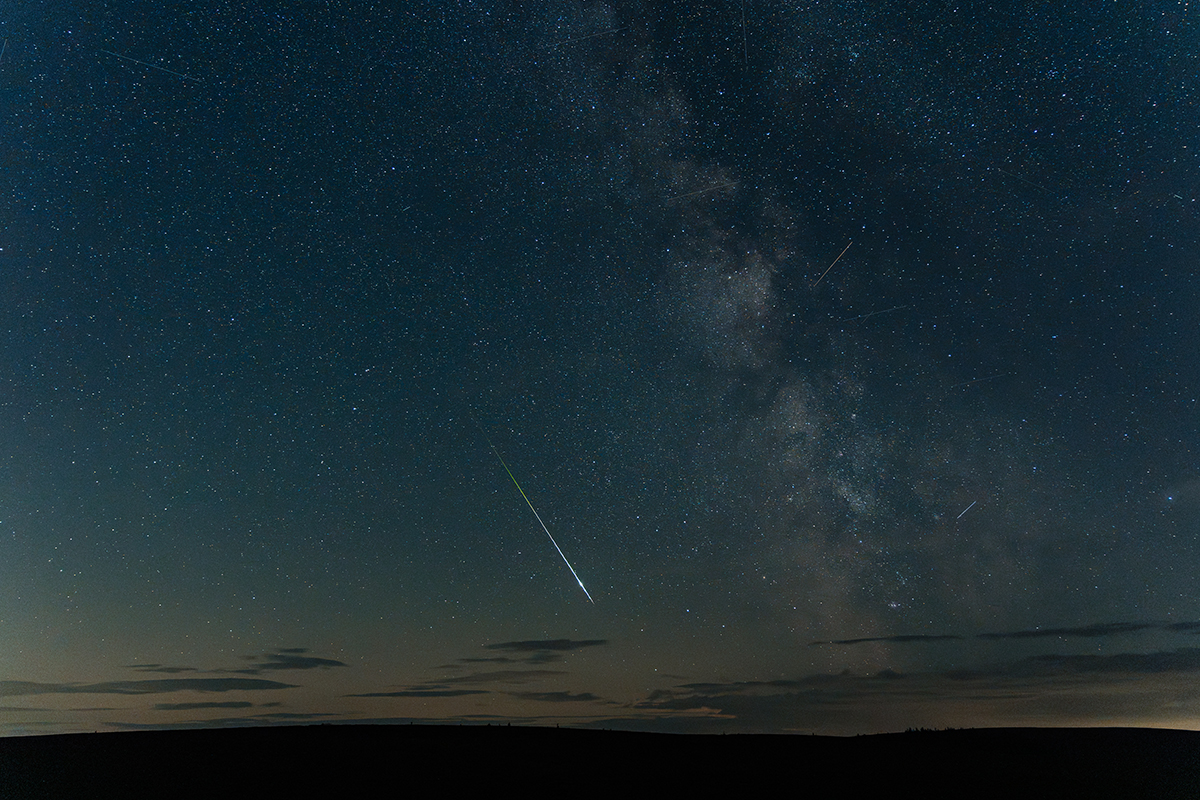
A single Perseid meteor cuts a clean line across the night sky, a sight that happens dozens of times per hour at peak from a dark sky location near Yellowstone.
Want to try to photograph the Perseid meteor shower? Want to capture the Perseid meteor shower near Yellowstone on camera? Here are the basics for beginners. Here are the basics for beginners:
You need a camera that allows manual settings. Smartphone cameras can capture bright meteors on very dark nights but a dedicated camera with manual controls gives you much better results.
Use a wide angle lens. The wider your field of view the more sky you capture and the better your chances of a meteor appearing in frame.
Basic settings to start with: ISO 1600 to 3200, aperture as wide as your lens will go (f/2.8 or wider is ideal), shutter speed 15 to 25 seconds. These are starting points — experiment and adjust based on your results.
Use a tripod. Any camera movement during a long exposure will blur your image. A stable tripod is non-negotiable for night sky photography. A stable tripod is the single most important piece of gear for photographing the Perseid meteor shower near Yellowstone.
Use a remote shutter release or your camera’s timer function. Pressing the shutter button physically can cause enough vibration to blur a long exposure shot.
Shoot in RAW if your camera supports it. RAW files give you far more flexibility in post-processing to bring out the stars without overexposing the sky.
Be patient. Capturing a meteor on camera is part skill and part luck. Set up your camera pointing toward Perseus, set it to continuous shooting or long exposures, and let it run. Review your shots periodically and adjust settings as needed. Patience is everything when it comes to capturing the Perseid meteor shower near Yellowstone on camera.
Your Perseid Meteor Shower Basecamp is Ready
Old Faithful RV Park sits on the North Fork of the Shoshone River in Cody, Wyoming, just 32 miles from the East Gate of Yellowstone National Park. Our Bortle Class 1 dark sky is one of the finest stargazing locations in the entire country and the Perseid meteor shower is the single best time of the entire year to experience it.
There is no better basecamp for the Perseid meteor shower near Yellowstone than Old Faithful RV Park on the North Fork of the Shoshone River.
Full hookup RV sites for big rigs of all sizes. Rustic cabins sleeping up to 6 with fresh linens included. And after the meteors fade and you finally head to bed, you fall asleep to the sound of the river right outside your door.
August is filling up fast and the Perseid meteor shower near Yellowstone peak dates of August 11 and 12 are the most requested nights of the month. Book your stay before they are gone.
Before your trip check out these helpful guides:
- Dark Sky Stargazing at Old Faithful RV Park : everything about our Bortle Class 1 night sky
- Yellowstone Itinerary Guide : day by day plans from one day to seven days
- Best Yellowstone Entrance Guide : why the East Gate near Cody is the smart choice
- Yellowstone Wildlife Safety : required reading before any nighttime outing in bear country
Frequently Asked Questions: Perseid Meteor Shower Near Yellowstone
When is the Perseid meteor shower in 2026?
The Perseid meteor shower peaks on August 11 and 12, 2026. These are the two best nights for viewing with the highest meteor activity. The shower is active from mid-July through late August so you may spot Perseids on nights before and after the peak too. For the most current predictions visit the American Meteor Society.
How many meteors can I see during the Perseids?
At peak under ideal dark sky conditions you can see 50 to 100 meteors per hour. From a Bortle Class 1 sky like the one at Old Faithful RV Park conditions are about as ideal as they get anywhere in the country. The Perseid meteor shower near Yellowstone offers some of the best naked eye viewing conditions in the entire country.
Where is the best place to watch the Perseid meteor shower near Yellowstone?
Old Faithful RV Park on the North Fork of the Shoshone River near Cody, Wyoming offers Bortle Class 1 dark skies right from your campsite. No driving or hiking required. Just step outside and look up. Inside the park Hayden Valley and Lamar Valley are also excellent but require driving at night in bear country.
Do I need any special equipment to watch the Perseids?
No. The Perseid meteor shower is one of the best naked eye astronomy events of the year. All you need is a clear night, dark skies, a reclining chair or blanket, warm layers, and a red flashlight to preserve your night vision. Binoculars and a camera are optional extras that enhance the experience. he Perseid meteor shower near Yellowstone is genuinely one of the most accessible astronomy events of the entire year.
What time is best for watching the Perseid meteor shower?
Midnight to 3am is the peak viewing window when Perseus is highest in the sky. However Perseids can be spotted any time after dark from a dark sky location like Old Faithful RV Park.
Is it safe to watch the Perseids inside Yellowstone at night?
Yes, but take bear safety seriously. Carry bear spray, go with a buddy, and stick to designated pullouts and parking areas rather than venturing onto trails after dark. Read our complete Yellowstone Wildlife Safety Guide before any nighttime outing in the park.
Can I see the Milky Way during the Perseids?
Yes. August is one of the best months of the year to see the Milky Way from a dark sky location. From Old Faithful RV Park’s Bortle Class 1 sky the Milky Way stretches from horizon to horizon on clear moonless nights and is bright enough to cast a faint shadow on the ground.
What are the best stargazing apps to use during the Perseids?
We recommend SkyView, Star Walk 2, and SkySafari. Download whichever you choose before you leave home since cell service is limited near Old Faithful RV Park.
Where is the best place to stay for the Perseid meteor shower near Yellowstone?
Old Faithful RV Park in Cody, Wyoming. Bortle Class 1 dark skies, full hookup RV sites, and rustic cabins sleeping up to 6 guests just 32 miles from the East Gate of Yellowstone National Park.
Rest. Explore. Repeat.